
Handheld vs Online TIJ Printer: Which Coder Fits Your Line?
Handheld vs online TIJ printer: choose a handheld coder when products stand still and an operator can move the printer across them, for example cartons in a warehouse, boards, pipes or small batches. Choose an online TIJ printer when products move past a fixed print head on a conveyor or packing line and every item must be coded automatically.
Both types use the same thermal inkjet (TIJ) cartridges, so print quality and ink choice are similar. The difference is how the printer and the product move. This guide explains each type, compares them in one table, lists the MufengTech models for each, and gives a 6-step method to pick the right coder.
What is a handheld TIJ printer?
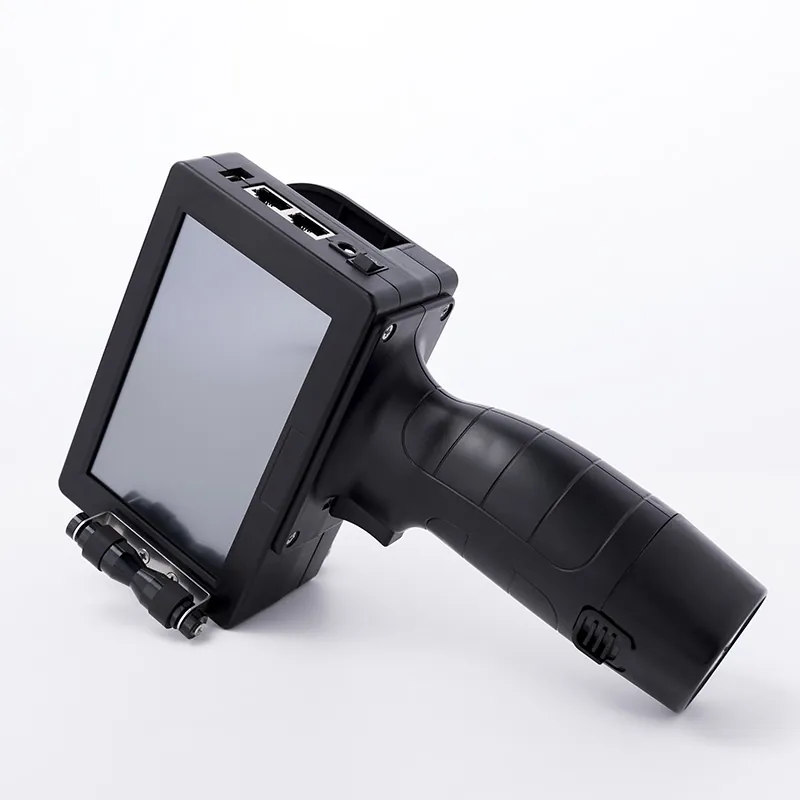
A handheld TIJ printer is a portable, battery-powered coder with the cartridge built into the printer body. The operator holds it against the product and slides it across the surface. A built-in encoder measures the movement, so the characters keep their shape at a steady hand speed.
The MF-G100 handheld inkjet machine is a typical example. It uses a TIJ 2.5 cartridge, prints 1 to 12.7mm high at 150, 300 or 600DPI, works best at a print distance of 1 to 2mm and runs on a built-in 7.2V 2600mAh lithium battery. It prints text, dates, serial numbers, counters, barcodes, QR codes and images.
What is an online TIJ printer?
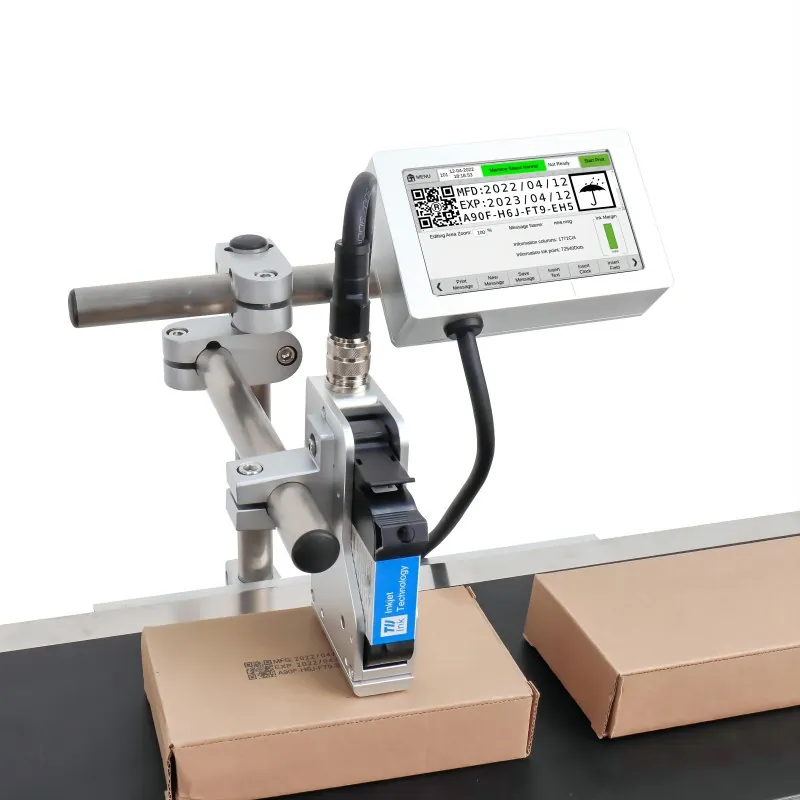
An online TIJ printer is a coder with a fixed print head mounted on a bracket beside a conveyor, packing machine or production line. A photocell (optical eye) detects each product and triggers the print, and an encoder can track the line speed. Nobody needs to touch the printer during production.
The MFT110M thermal printing machine, for example, has a 12.7mm head, a 5-inch touch screen and network, USB and RS232 interfaces. Its listed print speed is 406m/min at 90DPI, 240m/min at 150DPI, 120m/min at 300DPI and 60m/min at 600DPI. The MFT180E high speed variable date printing system supports large-capacity ink bags and a continuous ink supply system, and is designed to match weighing and paging machines.
Handheld vs online TIJ printer: comparison table
| Point | Handheld TIJ printer | Online TIJ printer |
|---|---|---|
| How it prints | Operator moves the printer across a stationary product | Fixed head prints as products pass on a line |
| Trigger | Built-in encoder and the operator's movement | Photocell or fiber sensor, plus encoder for line speed |
| Power | Built-in rechargeable lithium battery | Mains power through the controller |
| Print height | 1 to 12.7mm (MF-G100, MFG50); up to 25.4mm (MFT130) | 12.7mm (MFT110M, MFT180E); up to 25.4mm (MFT210E); taller with multi-head models |
| Best for | Warehouses, small batches, large or heavy items, products that cannot go on a conveyor | Continuous production, high volume, every item coded in the same position |
| Data connection | USB or RS232 (MF-G100); Wi-Fi and phone app control (MFG50) | Network, USB and RS232; remote centralised management on MFT210E |
| Code consistency | Depends on the operator's steady hand | Same position and spacing on every product |
| Set-up | Ready to use; no installation | Bracket, sensor and line integration needed |
When a handheld TIJ printer is the right choice
A handheld coder is the practical choice when the product cannot easily come to the printer. Typical jobs are coding shipping cartons on pallets, marking boards, pipes and building materials, adding batch codes to sacks in a store room, or coding small runs that do not justify a line installation.
It is also useful as a second coder. Many sites keep a handheld unit for rework, relabelling and urgent jobs, while the main line runs an online printer. If you need to control the printer from a phone, the MFG50 handheld inkjet machine connects over Wi-Fi to a mobile app and has a 4.3-inch colour touch screen. For codes taller than 12.7mm, the MFT130 handheld code machine prints up to 25.4mm and can be used handheld or online.
When an online TIJ printer is the right choice
Choose an online printer as soon as products move continuously on a conveyor, filling, bagging or packing machine. The print head stays at a fixed distance and angle, so every code lands in the same place with the same spacing. Dates, shift codes and serial numbers can update automatically through counters and a variable database.
Online coders also connect to other equipment. External interfaces for a photocell, encoder and, on some models, an alarm light let the printer work with the line. Online heads also need a steady gap to the product: the MFT110M and MFT180E specify 1 to 2mm, while the MFT210E allows 2 to 5mm.
How to choose between handheld and online: 6 steps
- Check whether the product moves. Products on a running conveyor point to an online printer. Stationary items, pallets or large parts point to a handheld coder.
- Count your daily volume. A few hundred items per shift can be coded by hand. Continuous high-volume production is easier and more consistent with an online coder.
- Measure the code height. Up to 12.7mm suits most models. For up to 25.4mm look at the MFT130 handheld or MFT210E online printer.
- Check the material and ink. Porous cartons and paper usually suit water-based cartridges; plastic, metal and glass need solvent cartridges. Both printer types use 42ml TIJ cartridges.
- Check the line speed and resolution. TIJ trades speed for resolution, from about 406m/min at 90DPI to 60m/min at 600DPI on models such as the MFT110M.
- Send samples or photos. Share your product, code layout and line details with our team, and we will recommend a handheld or online model.
Running cost and maintenance
Handheld and online TIJ printers are both cartridge-based: there is no ink system to flush and no make-up fluid. When a cartridge is empty you replace it, and the nozzles are renewed with it. Cartridges with a contactless RFID chip let the printer identify the cartridge and record the remaining ink. Cap a cartridge when you pause, especially with fast-drying solvent ink, and keep the nozzle plate clean.
Do your products move too fast, sit too far from the head or have strongly curved surfaces? A continuous inkjet printer may suit better; see our sister site cijinkjet.com for CIJ printers and inks.
FAQ: Handheld vs online TIJ printer
Can a handheld TIJ printer be used on a production line?
Some models can. The MFT130 handheld code machine is designed for both handheld and online use. For continuous high-volume lines, a dedicated online TIJ printer with a photocell gives more consistent codes.
Do handheld and online TIJ printers use the same cartridges?
Both types use 42ml TIJ cartridges in water-based or solvent ink. Check the cartridge type and print height supported by your exact model before ordering.
How fast can an online TIJ printer print?
On models such as the MFT110M the listed speed is 406m/min at 90DPI, falling to 60m/min at 600DPI. Higher resolution gives sharper codes at lower speed.
Can a handheld coder print QR codes and barcodes?
Yes. The MF-G100 prints barcodes, QR codes, images, serial numbers, dates and counters within its 12.7mm print height.
How do I get a recommendation?
Contact Shenzhen Mufeng Technology Limited Company on WhatsApp +86 158 1405 1051 with your product, code layout and line speed.
Written by the team at Shenzhen Mufeng Technology Limited Company. WhatsApp: +86 158 1405 1051